

Welcome to Sports Afield
Ask "Doctari"
Dr. Kevin "Doctari" Robertson answers your questions about practical ballistics, shot placement for African game, and more
About Dr. Kevin Robertson: Dr. Kevin "Doctari" Robertson is the author of the runaway bestseller on African game shot placement, The Perfect Shot, as well as a new book on the African buffalo, Africa's Most Dangerous. He is a wildlife veterinarian and licensed professional hunter in Zimbabwe and South Africa, and is the principal and director of the Eastern Cape Academy of Professional Hunting.
Ask Doctari a question
Question: Do you feel that a three-rifle safari is still practical today? Or can a person make do with two rifles (a medium and a heavy), or even just one?--D.C., Temecula, CA
Answer: I long ago realized that having more than one rifle on a modern-day African safari is both a hassle and a pain. I say this because it is my experience that the wrong rifle will invariably be on hand for the shot which prevents itself. Remember, a considerable portion of African sport-hunting revolves around luck, and just bumping into that exceptional, trophy-of-a-lifetime specimen, usually at the most unlikely or unexpected moment. This is a fairly common phenomenon and as the Boy Scouts used to say, one should always be prepared. The following incident is a perfect example of this.
My client and I were hunting out of H camp in the Sapi Safari Area of the Zambezi valley. I love this area because it’s one of the few where it’s possible to hunt big game by just walking out of camp. A magnificent old buffalo bull resided in an area of thick jess bush quite close to H camp. He was so spectacular in the horn department that various clients and I hunted for him on a number of occasions, but without success. Like so many of his kind, this old bull was super smart, to the extent that we reckoned he could have taught the Green Berets a thing or two about bushcraft, and it’s understandable, I suppose, that he became known to us as Old Wily.
Buffalo hunting is essentially a morning activity, because hunters want to leave enough time to complete the recovery before nightfall. Quite late one afternoon, my client and I went for an evening stroll down the banks of the Zambezi. The camp needed meat and as impala were common in the area, my client carried his .308 Winchester. We found a small herd of these skittish antelope a mile or so from camp, but just as we were about to maneuver into a shooting position, we bumped into Old Wily. He was obviously on his way to the river for a drink and a night’s feeding session on the lush green grass that grew along the water’s edge.
My client still had his buffalo tag, and there was the bull we all dream about, just standing there looking at us, less than fifty paces away, and there was nothing he could do about it! To this day I remain convinced that Old Wily knew my client was inadequately armed! For a good few minutes he taunted us before tossing his impressive horns and trotting off. As I’m sure you can imagine, the walk back to camp was in brooding silence.
I now prefer my safari clients to use a rifle which will cover all the bases; in other words, it should be suitable for all the species on the bag list. “Beware of the man with only one rifle” is a well-known saying and with good reason: he’ll hopefully know how to use it. In my book, total familiarity and absolute confidence in a safari rifle are critically important factors, and you’ll gain them more easily with a single rifle which you’ll carry constantly while on safari than you will with the various rifles in a battery. So what caliber/cartridge/bullet combinations are we talking about? This will depend on the species being hunted, but bear in mind the following. In dangerous-game country, I’ve long believed one needs to be adequately armed for any eventuality. In my opinion, it’s better to shoot an impala or a bushbuck, even a duiker, with a .375 H&H or a .416 than to face the remote but possible situation of having to stop an elephant cow or an old dagga boy with only a .30-06 in your hands. I know of three Zimbabweans who were all gored by buffalo while hunting Zambezi Valley bushbuck. All were inadequately armed when these incidents occurred and one even shot and killed the buffalo with his .270, but not before it gave him a thorough going over.
Elephant hunts are the most specialized, and this is where I see the need for a heavy rifle, either an open-sighted double or a turnbolt in at least .458 caliber.
Buffalo hunts, either on their own or in conjunction with leopard and/or plains game, do not in my opinion require a heavy rifle, certainly not with the wonderful array of good quality bullets available today, in a wide selection of weights. A good-quality scoped rifle in a medium to large-medium caliber will suffice for this type of hunt and there are a number of options that will do the job adequately. The venerable .375 H&H, the .400 Tembo, the new .400 H&H, the .404 Jeffery or one of the .416s will all work just fine. Top the rifle with a good quality 1.5-5X or the new Swarovski Z6 1–6X scope and you’ll be better served than having a heavy for buffalo and a lighter rifle for the leopard and plains game.
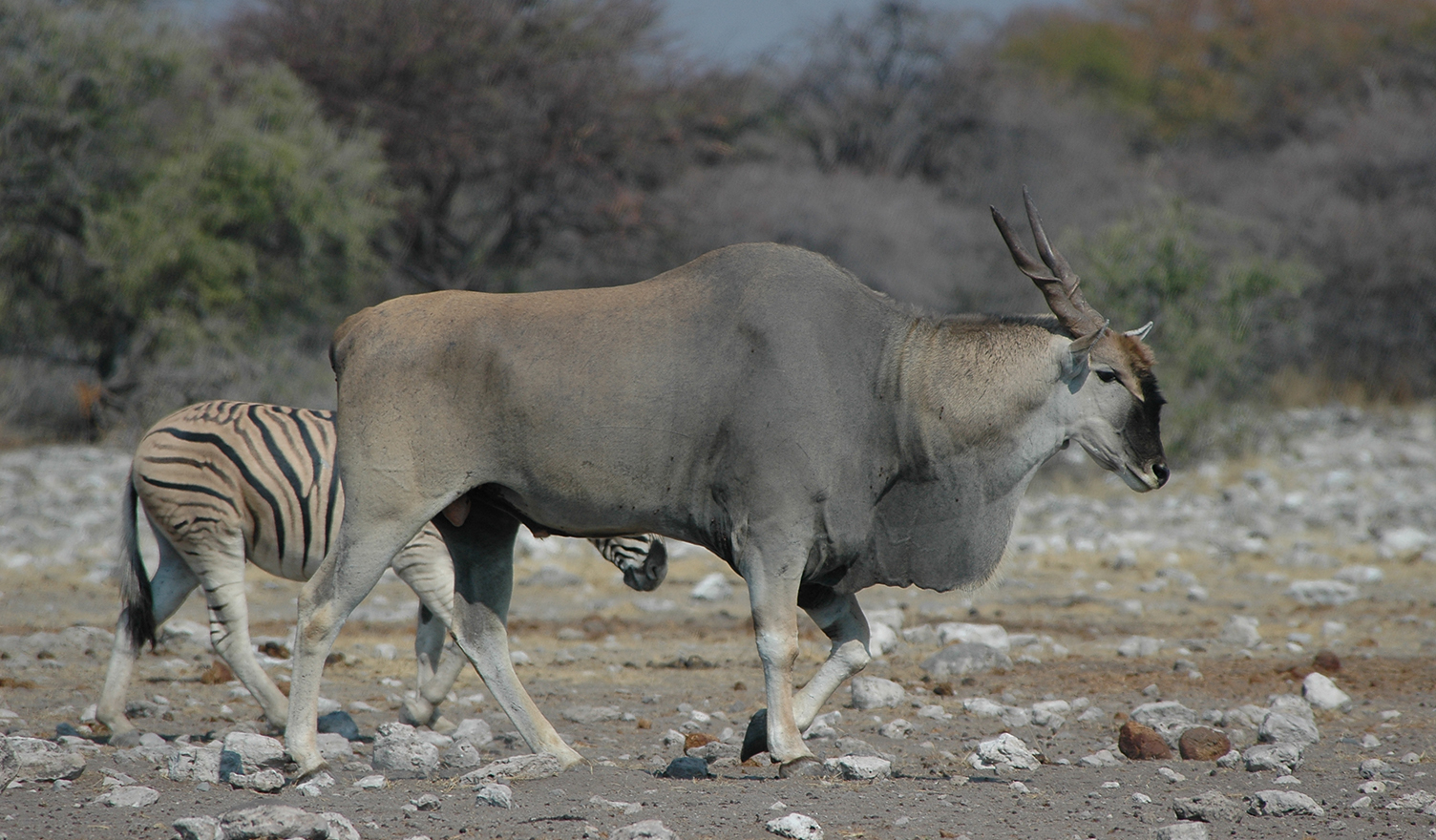
The same goes for leopard/plains game hunts. If eland are to be on the menu, your selection should be adequate for them--and I’m recommending either the .375 H&H or one of the .35s or .338s. If eland are not on your list, then you can come down a notch to one of the .30 calibers. The selection for a straight plains game hunt should be determined by the biggest/toughest species to be hunted, but generally any of the various 7mms or .30 calibers will suffice.
Question: Where are the most economical buffalo hunts found in Africa today?--J.D., Flint, MI
Question: I bought a new big-game rifle for my first safari and I know I need to shoot it a lot before I go. Can you recommend a pre-safari practice regimen?--J. Jenkins, Long Beach, CA
Read Answer
Read more questions and answers by Dr. Kevin Robertson in every issue of Sports Afield.
|