

Warm-weather Muskox

Hunting the shaggy denizens of the north in Greenland.

By Craig Boddington

The muskox, or as its Latin name, Ovibos moschatus, better describes it, “musky sheep-ox,” is an Arctic animal. The Arctic is cold country, and although there is always a (sort of) Arctic summer, I have long understood that most people hunt them during the winter for two good reasons. First, mobility is a whole lot easier after freeze-up. Second, an important part of the muskox trophy is its incredible shaggy coat, so it stands to reason you want to hunt them in the winter, when the coats are most luxurious.

My previous experience validated this. I was among the first to go, clear back in 1981, when the Northwest Territories first opened up nonresident permits. That was in November on Victoria Island. Yes, the coats were great, and mobility--snowmobiles on ice--was just fine. On the other hand, the morning grayed up just a bit about 10 a.m., and it was full dark again about 3:00. The sun just barely peeked over the horizon for maybe an hour. It was a short hunting day, and an awfully Arctic night! It was a great experience, but I don’t think I’d do it again! I did go again in the early 1990s, this time out of Coppermine on the mainland, and this time in April. It was a whole lot warmer, all the way up to 0 degrees Fahrenheit. Travel was fine, and the days were very long.

I’d do that again if I had to. But here’s the reality: Arctic weather isn’t just tricky; it’s dangerous, and you’re playing with the weather. On that first hunt we got in between two storms, got a great muskox, and got back to the village. On my second hunt we put into a fisherman’s shack--technically we broke in, but my Inuit guide swore the owner was his uncle--and waited out a storm for three days. Which meant our actual hunting time was pretty short. That in itself isn’t all that terrible. Given a bit of luck it isn’t all that difficult to find muskoxen, especially when you’re glassing for them on a pure-white background; they stand out like peppercorns on a bedsheet. But add a bit of weather to a relatively short hunt, and then factor in unbearable cold. Most hunters, me included, take the first mature muskox bull they see!


Greenland's southwestern coast has a mild climate as muskox habitat goes, and the animals thrive here.

Sometimes you get lucky. My first muskox stood as SCI’s world record for a little while, and it was the only bull I actually saw! My second bull was OK, but we lost so much time to weather I was fortunate to get one at all. So the concept of really looking over muskoxen, a lot of muskoxen, in search for a really big one, is totally foreign to me.

Surprisingly, that’s exactly what we were able to do on an August hunt in Greenland. Oddly, it wasn’t even muskoxen that drew me to Greenland. Last year I hunted European reindeer in Iceland with Bjorn Birgisson of The Icelandic Hunting Club. Reindeer are reindeer, essentially the Old World version of caribou, but Europe starts in Iceland and North America starts in Greenland. Bjorn also outfits muskox and reindeer on Greenland in July and August. Note: Early muskoxen hunting is also available in Canada, but I steered clear of it because I understood, incorrectly, the coats weren’t any good. Bjorn made it sound like a lot of fun, and indeed he was correct.

Muskoxen are native to Greenland (that’s why they have both a Greenland and barren ground race, right?). The herd we would hunt were reintroduced along the southwestern coast, which is much milder than northern Greenland. They have done extremely well, increasing not only in numbers, but in body and horn size. The native caribou on Greenland were nearly wiped out by 1800. Reindeer were first introduced in 1900, with another release in about 1950. They’ve done well and are totally free-ranging, so the lure for me was a “North American” reindeer, an animal I hadn’t hunted before. I didn’t really want another muskox, so I figured I would hunt reindeer and Donna could hunt muskox.

Donna Boddington and Alice Poluchova pulled a very nice double on reindeer.


To paraphrase the horrible “Ollie and Lena” jokes, ‘that Bjorn, he’s a smooth talker, by golly.’ Before I knew it, we were each going to hunt both, joined by CZ USA’s Alice Poluchova, who would also hunt one of each. That sounded like a tall order for just a week’s hunt! It was, but I’m sure glad we did it that way.
 

The hunters glassed from a boat, then hiked ashore when something interesting was spotted. In summer, the fjords are filled with icebergs.


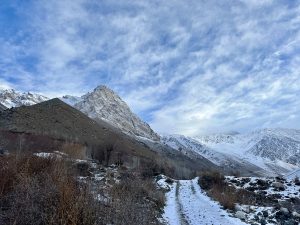
Most of Greenland is a huge glacier, so the real habitat is confined to coastal strips along the rugged fjords. On foot it would be extremely difficult, but we glassed from a sturdy boat, then went ashore to take a closer look. We hunted muskoxen first, then moved a little farther east where the southern reindeer are concentrated. In the end Alice got the largest reindeer, so I think it’s OK to admit that she got a bit cheated in the muskox department. It was totally inadvertent, but it was also totally my fault!

We are all victims of our experience, and my experience with muskoxen was: A. We would see very many; and B. We’d better not mess around. So, trying to do the right thing, I insisted on ladies first--first Alice, then Donna--and it would be okay if I didn’t get a muskox at all. So, on the first morning, we walked out from the old fishing village that served as camp, and Alice shot a very nice bull before noon. The horns were plenty big enough and, surprise, the coat was just fine. All she missed, which is quite a lot, was the chance to really look over these strange creatures.

Well, heck, I’d hunted them twice before and I’d never looked them over, either. So it didn’t bother me too much until we got in the boat and started cruising a thoroughly magnificent coastline. We saw lots of muskoxen. I mean, lots of muskoxen. Our Inuit guides knew what they were looking for. It wasn’t just the horns, but also the age. They wanted older bulls that hadn’t yet started to wear their horns short. Young bulls they could tell from a distance--I sure couldn’t--but now that it was Donna’s turn, we stalked and passed up a number of spectacular bulls. This one had a worn tip on one side . . . that one was awesome, but had a weird gap or hole on one boss. I thought this was silly until they gave her the green light, and she got an awesome bull. Mine was just fine, and with an extra permit in hand, Bjorn shot one that also very fine. But Donna’s was the biggest of four very good bulls, all in the nine- or ten-year class.

During the muskoxen portion of the hunt we had glorious weather, frosty in the morning, pleasantly cool on warm afternoons. But the Arctic is the Arctic and good weather can’t last forever! When we shifted to reindeer it started to rain (reindeer in the rain, catchy!). This was OK, since we could glass from the covered cabin and pilothouse of the boat. The ceiling also came down, which wasn’t so OK. We could only see a few hundred yards inland, and then the ridges were in the clouds. I drew first shot on this one, since the reindeer was all I really wanted. So I did the best I could, and then, in the way these things work, at the eleventh hour Alice and Donna pulled a snappy double on two really fine bulls. And that was just fine with me.

I don’t think I have time or inclination to become an expert on muskoxen (or reindeer!), as it probably doesn’t offer much future as a writing specialty. But I’m still learning, and I learned that you don’t have to freeze your tail off to hunt these unique animals. Maybe you’re better off to hunt them in balmy weather, when you can take your time!


We took four very good bulls in just a couple of days, but this big muskox taken by Donna Boddington was the best. It's hard to judge the size of the boss because of the long hair, but there is no mistaking the deep curls and long tips.


Your rating: None Average: 3 (2 votes)