

|
||||||
|
America’s Best Exotic
The nilgai of south Texas offers a challenging and inexpensive fair-chase hunt during the off-season.
By Craig Boddington
Two sand ridges away, two bulls were fighting, throwing up great clouds of dust. We watched them spar for a few moments, and then Michael DeWitt led the way off our ridge into the thick brush below. If we hurried, maybe they’d both still be there. There were cows up there, too, and the wind was right, so at least the winner would still be close by.
Nilgai hunting is generally a combination of glassing and stalking, and sometimes pure still-hunting. They are more diurnal than nocturnal, and you will usually find them along the edges of heavy cover in the mornings and evenings.
It took us a half-hour to work our way through the thick stuff to the far ridge. The fight was over and the bulls seemed long gone, but two or three drab cows were just drifting off the open ridge into the cover beyond. We let them go, then followed their general route. There were bulls in here somewhere.
After a few hundred yards we came to another narrow opening and Mike put up the sticks. A cow was just stepping into the clearing from the right, and a bull could well be behind her. He was not. Instead he was in front of her, and in front of us, staring at us through a small gap, seen almost too late. I swung the rifle around, knew the clock was ticking, got the bead on the point of his shoulder, and got the shot off.
The bull was a nilgai, Boselaphus tragocamelus, the strange-looking, short-horned antelope imported from India into the Texas Gulf Coast country many years ago. “Nilgai” means “blue bull” in the Hindi language, and that’s what we call the mature bulls. This blue bull bucked hard, then ran to the right, covered by brush just as I fired a second shot. I knew I’d hit him well, and I knew I had enough gun, the old .348 Winchester with 250-grain bullets. I also knew nilgai, so I knew that all bets were off, and we might be in for a very long day.
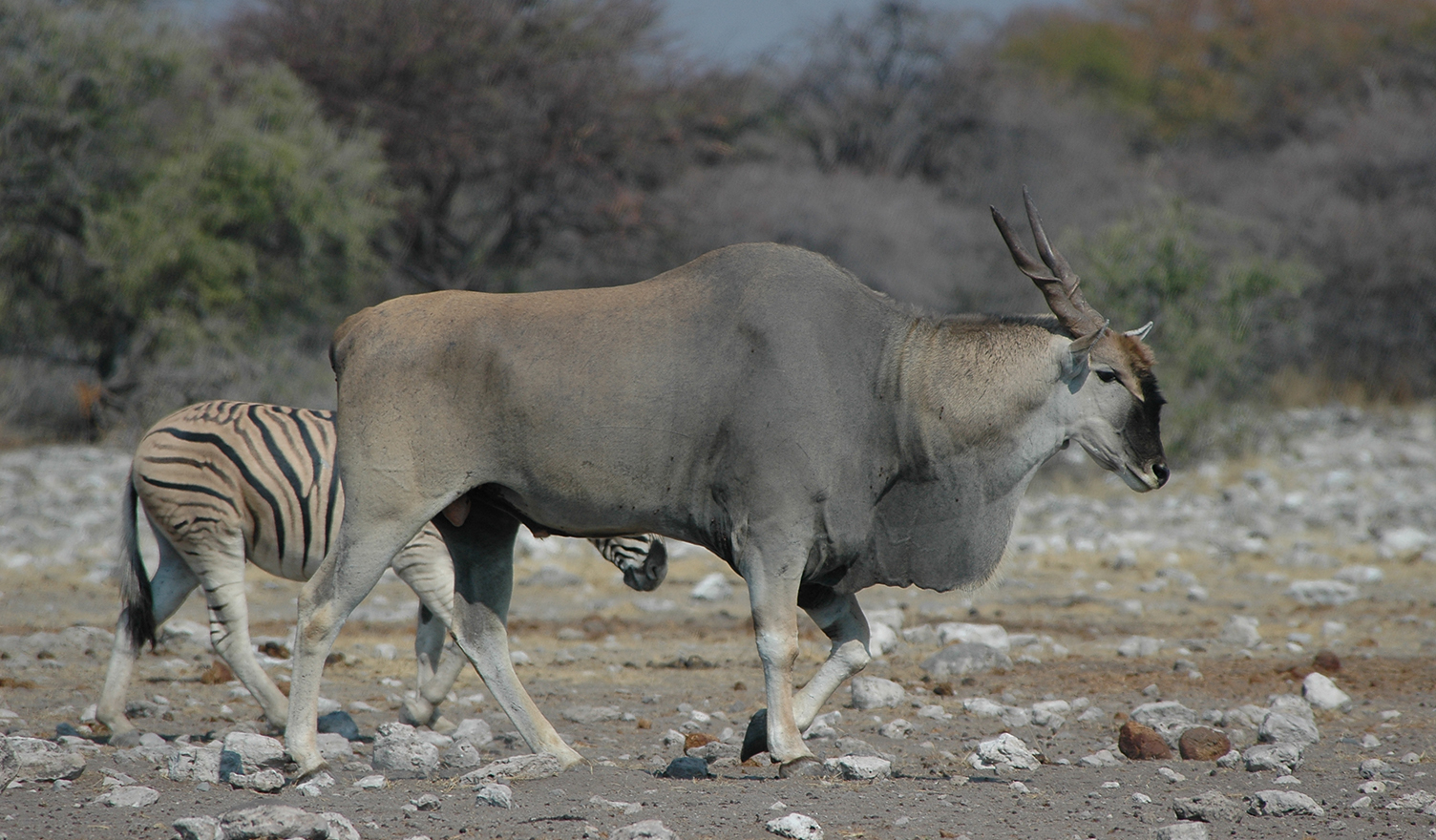
The nilgai is a big, powerfully built antelope, tall in the shoulder and low in the hip, like a sable or roan. The bulls are much larger than the females, occasionally exceeding six hundred pounds. Cows and young bulls are beige or light brown, with the bulls growing darker as they age. At prime breeding age the bulls are often a dark blue-black color, giving the animal its “blue bull” nickname—but this color often fades with age, the oldest bulls seeming to be more of a bluish-gray. The horns are short, thick “devil horns,” averaging ten to eleven inches. Ah, if nilgai just had horns like a kudu or a sable! But they don’t. You must love them for what they are, and what I admire about them is their innate wariness and amazing toughness. They are able to soak up a tremendous blow and still attempt to make good an escape. The hide is thick, especially on the shoulders, so there is usually little external bleeding, and the South Texas soil makes for very tough tracking.
An animal of the tropics, the nilgai is very susceptible to cold. They thrive along the Texas Gulf Coast, free-ranging on the big ranches there in tens of thousands—but they don’t go very far inland, and they don’t go very far north. The rare freeze there hurts them, but they bounce back quickly. This country is also famous for big whitetails and oceans of turkeys and bobwhite quail, but I tend to think of the nilgai as the real jewel of Texas’ narrow coastal plain. They’re difficult to hunt, provide superb venison, and offer a genuine and inexpensive fair-chase hunt during the off-season months of late winter and early spring.
I “discovered” them a quarter of a century ago. The occasion was a writers’ seminar southwest of Corpus Christi. We were offered the choice to hunt whitetail or one of several different “exotics,” one of which was nilgai. Almost none of us had hunted nilgai or knew much about them. I hunted whitetail, but a half-dozen colleagues chose nilgai as “something different.” At that time there had been almost no commercial hunting for nilgai. They are naturally spooky, with a huge “flight radius”—but there were lots of them, and they were relatively undisturbed. The problem was the equipment. The “featured product” was a new lightweight rifle, mated with a new load carrying a light, fast bullet.
For whitetail, and the rifle, cartridge, and bullet were perfect. For nilgai, well, that was a different story. Penetration was simply inadequate, and at the end of the first day we were looking for several lost nilgai. I saw one of these shots, a broadside presentation at a bit over a hundred yards—and I saw the puff of dust fly on the exact center of the shoulder, a perfect shot. We never found a trace of that nilgai. Well, maybe we did. A day later, while hunting whitetail, we spotted an obviously sick nilgai by a waterhole. I circled and came up behind him, putting him down with a shot to the base of the tail. He had a bullet hole in the exact geometric center of the shoulder, but when I field-dressed him, the inside of the ribcage wasn’t even bruised!
Boddington and guide Michael DeWitt with a good nilgai bull. This is an old bull with his heavily scarred hide starting to go gray, a fine trophy. The rifle is a Winchester Model 71 in .348, a good class of cartridge for these tough animals.
Since then I have had utmost respect for nilgai. I’ve hunted them many times, often with big guns. There is no shame in using powerful cartridges like .375s and .416s, and I tend to think something on the order of a .338 is probably just right. In other words, they offer a great opportunity to try out the big guns that we don’t get to use very often. On the other hand, I have also learned that it’s really all about the bullet, not the cartridge. With extra-tough, deep-penetrating bullets, it’s possible to drop all the way down to .270 and cleanly take nilgai. But whatever you use, you’d better be careful, because you can’t count on a blood trail, and you can always expect a wounded nilgai to head for thick cover.
We found blood right away on this last nilgai I shot, and he lay up very quickly--definitely benefits of larger bullets. Whether from an unseen wobble or iron sights covering too much of the animal, I’d missed the line on the quartering angle and hit just a bit back on the shoulder. He got up when we approached, but it was open enough for follow-up shots and this time we got him down for good. His horns were average, but he had a big body and great color, and that odd beard on his dewlap. I thought he was magnificent, and I hope I can hunt his tribe many more times.